Showing posts with label Quilting Projects. Show all posts

Tuesday, November 18, 2014

Updates: Delicate Arch Finished and More

I have again been a big blogging slacker.  So much to do, so little time.

I finished Delicate Arch the end of August, because I wanted to enter it into a local judged art quilt show.  While this was a big challenge, I am pleased to write that the efforts more than paid off: my quilt placed second on that show.  First time I placed in a formal competition!

To recap the progress:
Original photo I took


Nearly done with fabrics

Final fabrics, coloring and beginning threadwork
Delicate Arch completed

After that, we traveled through parts of Greece and visited friends and family in Germany.  Some of the pictures we took in Greece may form the inspiration for my next quilt.

Meanwhile, I have been avidly spinning and knitting - have some Christmas presents to complete.  I especially have been having fun dying wool before spinning.  Many of the color concepts in quilting and painting fabric I have had a chance to apply to dying.  I hope to soon post a short series on these projects.

I also have been teaching some classes in free motion quilting and freezer paper piecing.  The proceeds help fund my fiber vices!

Tuesday, August 5, 2014

Delicate Arch - Continued

Work on this has been slow.  I have had other commitments and some things should not be rushed.
The first thing that I learned, at least for this style of quilt, I am better off to stitch first and embellish with paint and pencil afterwards, and that sparingly.  I botched some areas from the get go and had to replace them. This is where sewing the pieces with clear thread pays off.  It pulls easily or you can sew a new piece on top of the last one and it doesn't show.

Embellishment and quilting are proceeding in the same order as the piece placement - from background to foreground.  I started with the sky and opted to do back and forth lines in the darker area and just straight rays in the lighter area, emulating sun rays.  The clouds also just had some back and forth quilting, with some of the white thread going out for cloud wisps.  Then I used water soluable oils and colored pencils that were blended with floating medium to color the clouds and deepen the horizon.

All along the dark purple on the right that had a supposed sun spot was bugging me.  I finally decided to replace it with a fabric that sort of emulates a dark region with light streaks in it.  I am not after a faithful rendition of the scene and this comes across better than what I had. Once that was replaced, I needed to change the foreground a little.  I am now happy with what I have.

In the meantime, the first mountain ranges have been quilted.  I have two more ridges and the front basin to go and then I will tackle the arch and foreground.  I have done a little on the arch with rust thread to define some of the major cracks and will add a few more such details last.

Hopefully I'll have a finished quilt by the end of next week!  It needs to be done by the end of the month for sure, as I intend to enter it into an art quilt show.

Current status of Delicate Arch

Monday, June 30, 2014

Delicate Arch - Phase 2


So now that the pieces were placed on my Delicate Arch quilt, I needed to sew them down.  I used clear thread, so that it would not interfere with the quilting, threadwork and paint that are still to come.
My fears that the pinned pieces would pucker were fully justified, but actually easily dealt with.  I switched from my usual non-hopping quilting foot to a hopping  foot .  This prevented a wall of fabric from developing as I moved across the piece. Except for the independent clouds, I had to work in the same sequence as I had placed the pieces – from back to front.  I removed the rocks and arch from the foreground.  Then I folded back the fabric covering the furthest back piece, and thoroughly starched and pressed the area.  I only sewed the exposed edges.  If the piece extended all the way across the quilt, I would start at one edge and finish at the other.  Most pieces met under the arch, so I would start there and work to an edge.  When one layer was done, I would fold the overlapping piece down and fold back the piece that was on top of it, starch press and then sew.  I repeated this until all the background had been sewn down.  While quilting I made sure I kept things smooth, but avoided stretching the fabric.
Then I replaced the arch.  I also decided to add an extra layer of batting under it and the rocks.  I had trouble getting the arch the same way – this is certainly an argument for having the clear overlay rather than using the overhead projector, which I had already moved.  I ended up having to cut a new piece, because I had manipulated one piece to death.  I also modified a few pieces and added a lighter colored piece at the very top. Then I sewed it down and trimmed the extra batting to the sewing line.
After this I added the fabric backing.  I thought I was ready to start the embellishing and quilting.  However, when I compared what I had to how the arch was placed before, I realized the arch was now about an inch lower.  The delicate nature of the arch and the airiness of the sky seen through the arch were lost.  DAMN.  I considered removing the arch and placing it higher, but quickly realized that ripping out all that stitching was probably going to distort or destroy the fabric.  So I decided to reduce the size of the background landscape pieces behind it: fewer stitches to remove and cutting the ragged edges that resulted.  In the end, I think doing this gave the background a greater feeling of distance than it had before.
I am happy with what I have.  Now I need to figure out exactly what I am going to do next.  Stay tuned.

The original pinned piece before sewing

Immediately after sewing, arch seems too low and heavy.

After reducing some of the background to put more air under the arch

Friday, June 27, 2014

Freezer Paper Raw Edge Appliqué


It’s been a while since I have tackled an art quilt.  I have been doing small journal page style pieces, but nothing large.  Mainly exploring and practicing with different techniques.

Some of my journal pages.

Last month we took a trip through the beautiful national parks in southern Utah.  I came back inspired and after much consideration, I selected to interpret Delicate Arch at sunset.
 
I have experimented with different techniques in every art quilt I have made so far.  I am searching for something that is not too tedious – it takes away from the fun, creative part of the process – but still allows me the control I am seeking.

What I find most tedious are the multiple tracings required, especially if using iron on fusible.  Besides the drawing of the subject, you need the reverse to trace onto the fusible.  Each tracing is slightly different from the original.  Fusible also leaves a residue that will degrade the fabric over time (see this research) and I find it stiffens the fabric enough so that the needle sort of clunks through it.  I think it has its place, but I would rather minimize its use.

Some artists like Ellen Lindner free hand a lot of their stuff.  I do a bit of that, especially when filling in details or the like, but I am not good enough to render a known subject like Delicate Arch sufficiently well to have it remain acceptably recognizable.

I did a few quilts using Ann Holme’s “No Sewing Until YouQuilt It” freezer paper approach.  Works well, but I feel I can’t do the finer details with turned edge like I want and there’s no room to make changes on the fly.

So this time I am trying something that sort of combines some things I have done. 
  •   I first print out a full color picture of what I want to interpret.
  •   I slide that into a clear sheet protector you can buy at any office supply place.
  • I outline the parts that will be fabric pieces.  I try to not get too detailed. I will add fine details as I go or they will be added with thread and/or paint/colored pencils.
Original print and the clear tracing - 8.5 by 11.

  •   I then take the print out of the sleeve.  The drawing on the sheet protector needs to be made full size for the master template.  You can take it to a copy shop to have this done or print out sections of the image and tape it together.
    •   I happen to have an overhead projector.  They are expensive, but I use it for a variety of things, including as a light table and when I teach classes.  I project the image onto my design wall, onto which I have pinned paper the size I want the project to be.  I then trace the image onto it.  I also leave the projector set up for when I place my fabric onto the background, to check placement.  Otherwise you need a large piece of clear material, like vinyl or sturdy plastic (think paint drip sheets) onto which the full sized image has been traced.
  • I start with a piece of thin batting and a piece of white fabric or muslin cut several inches larger than the final size.  If the background is sky, I tend to paint that  directly on the white fabric (I did in this case).  I pin the batting and fabric piece to my design wall so that the image projects correctly on the piece.  If you are using the clear plastic, this is pinned at the top over the background, so you can lift it for fabric placement.
  •    I place the master tracing on a large table and decide the sequence.  You always start from the back and work to the front and when possible place darker fabrics over lighter ones.  I number the pieces in their order.  
Full sized master with numbers drawn.  I started out outlining the pieces with marker, but found it unnecessary. I stayed with pencil to get a better tracing.

  • I trace each piece onto freezer paper and label it with its number.  I decide which edge will show when tracing (solid line) and which edges need to be cut larger to fit under the next piece to be cut (dashed line).  Once I have selected the fabric, I iron the template on and cut the piece out.  I peel off the template and position the fabric onto the background and pin it through the background and into the batting, but not into the design wall, using the projected image (or the clear overlay) as a guide to placement.  I keep doing this until all the pieces have been placed.  I make changes along the way.

Freezer paper template.  Note that the left edge extends into the next piece - this will be underneath that fabric.


The beauty of this is that if I don’t like a fabric, I can take it out.  I have the template and can iron it onto another piece of fabric.  I ended up completely changing the background – I felt that what I had planned interfered with the focus of the piece, the arch.  I simplified what was in the background and subdued the colors and details.  The arch itself I tried to render fairly faithfully.  Pinning allows changes to be easily made and you are not endlessly tracing and ironing on fusible.  Each of those tracings would be slightly different. 

The next big question, is how easy it will be to sew the pieces down without ending up with puckers, etc.? I have done something like this before with good results. I’ll use clear thread for most of this part.  The arch will be partially peeled back so I can sew continuous lines across the background pieces. After getting the pieces attached, I will complete layering the quilt and do the quilting and embellishing. I am deciding whether I will use a second layer of batting – I may under the arch and the foreground rock for a more 3D effect. I’ll post those results hopefully soon.

Ready for sewing down.

Tuesday, June 18, 2013

Snowy Meadow


I just realized that it has been over 2 months since I posted last.  Not intended, but I have been busy and not inclined to write.

I have been taking an assortment of courses in quilting and in knitting on Craftsy.  I really like this approach – the courses are not more than 40$, often on sale and some great ones are free.  They are available forever and you can ask questions.

One course that I have gotten a LOT out of is Annette Kennedy’s Painting Pictorial Quilts.  I had been painting fabric ala Mickey Lawler Skydyes, but I wanted to do more with paint.  Granted, there are some quilters out there like Pat Durbin and Susan Brubaker Knapp who paint wholecloth and then embellish with thread, etc.  I don’t quite want to go that far, but I definitely can see using paint for shadows and highlights to create more depth and details that thread might not do as well or the way I want it to.

Probably the biggest thing I got out of the course is understanding acrylic paints and how to use them on fabric.   Fabric paint is formulated to bond to fabric threads.  Normally you thin them with water which allows them to spread and mix.  However, that’s the last thing you want to happen when using it to enhance details, etc.  You need to be able to control where it goes as well as its strength.  For that you use floating medium.  It’s a gel that allows you to control where the paint goes.  It increases drying time as well.  Afterwards you heat set it like any other fabric paint.  The nice thing, even if you aren’t using transparent paints, you can make opaques semi-transparent through the use of floating medium.  

Ann’s basic approach to mixing is to first mix the basic hue full strength in one of the divots of a mixing plate.  Then put a small glob of medium in another divot and quite a bit more into another and even more in a third.  Use a palette knife to add small amounts of the full strength paint to the three.  That way you get dark, medium and light tints of the same “mother color”.  Try them out on a scrap piece of fabric until you have what you want.  You may need more medium or more paint. You need to see these dry, so a hair dryer makes this happen quicker.  You never use white to lighten – just the medium.  If you need a shade or a tone, then you have to add black or gray up front before adding the medium.

You don’t have to use acrylics specifically designed for fabric.  Textile medium works like floating medium but additionally makes any acrylic bond to fabric.  I used to do Bauernmalerei (tole painting) and have a large collection of acrylics, which I can now also use on my quilts with textile medium.  Both floating medium and textile medium can be found at craft and art stores.


There are water soluble oil crayons. Some, like Neocolor, are really expensive, but Crayola makes  great ones in their Portfolio series that work equally well and are far cheaper and more widely available.  Your options are to draw on the area and then spread it out with float or textile medium or to add the color onto the palette plate and then mix in the medium.

All this information came at an opportune time, because I had started another project based on an article written by Martha Ginn for American Quilter magazine about Ghost Quilting.  Unfortunately, I decided to use a dark background (her examples are all light background) and nothing was working for me.  With the acrylic paints and textile medium I was able to finish Water Iris.  I fused a small piece of fabric not quite centered onto the dark background fabric.  Then I painted in the flowers beyond this margin.  I also outlined quilted other elements as well.

Water Iris 18 by 24 inches

I completed the two projects in Ann's Craftsy course: Calla Lily and Desert Trail.  


 The original desert trail design had a paved road, but I opted to convert that into a trail or jeep track and add Joshua trees.

Next, I signed up for Gloria Loughman’s Linear Landscape Quilts at Craftsy.  The use of a background fabric over which is fused the main color to create the contour lines attracted me.  Rather than doing the provided project, I thought the photo taken by my friend Kyle Funke was sufficiently similar and let me do my own work.  I learn more that way.

When I had finished the basic assembly, which uses very little quilting, I decided I wanted to do more with this quilt.  I added a tree to the foreground and created and enhanced bushes, fine branches and the like with thread sketching.  Then I decided to try using paint to add more detail and depth.  This really worked well and I am very pleased with the results.

Snowy Meadow - 22 by 16.5 inches
I am particularly happy that I could combine what I have been learning in several courses (including ones not on Craftsy like Ellen Lindner).  

Then I was approached by Craftsy to be featured in their blog.  Wow, that’s a huge ego-hug, if ever.  I am so touched by the very positive response this quilt has generated – thank you, all!  At this point, it’s going into a quilt show this week – wish me luck!

I think I am finally finding the collection of techniques and tools I need to create the type of art quilt I want to make.  I now plan on refining my skills with a series of smaller quilts based on flowers.  I am going through my pictures to pick out the first ones to try.  I’ll keep you posted.

Monday, April 8, 2013

A New Sewing Table


A former work colleague and friend named Tom loves woodworking the way I love quilting.  The challenge of creating a useful piece of furniture, the joy of working the wood, the precision and craftsmanship involved – these are parallels that can be found in  quilting.  Tom has made several pieces for me and one for my daughter.  He made a beautiful cherry wood quilt rack as my retirement gift. 

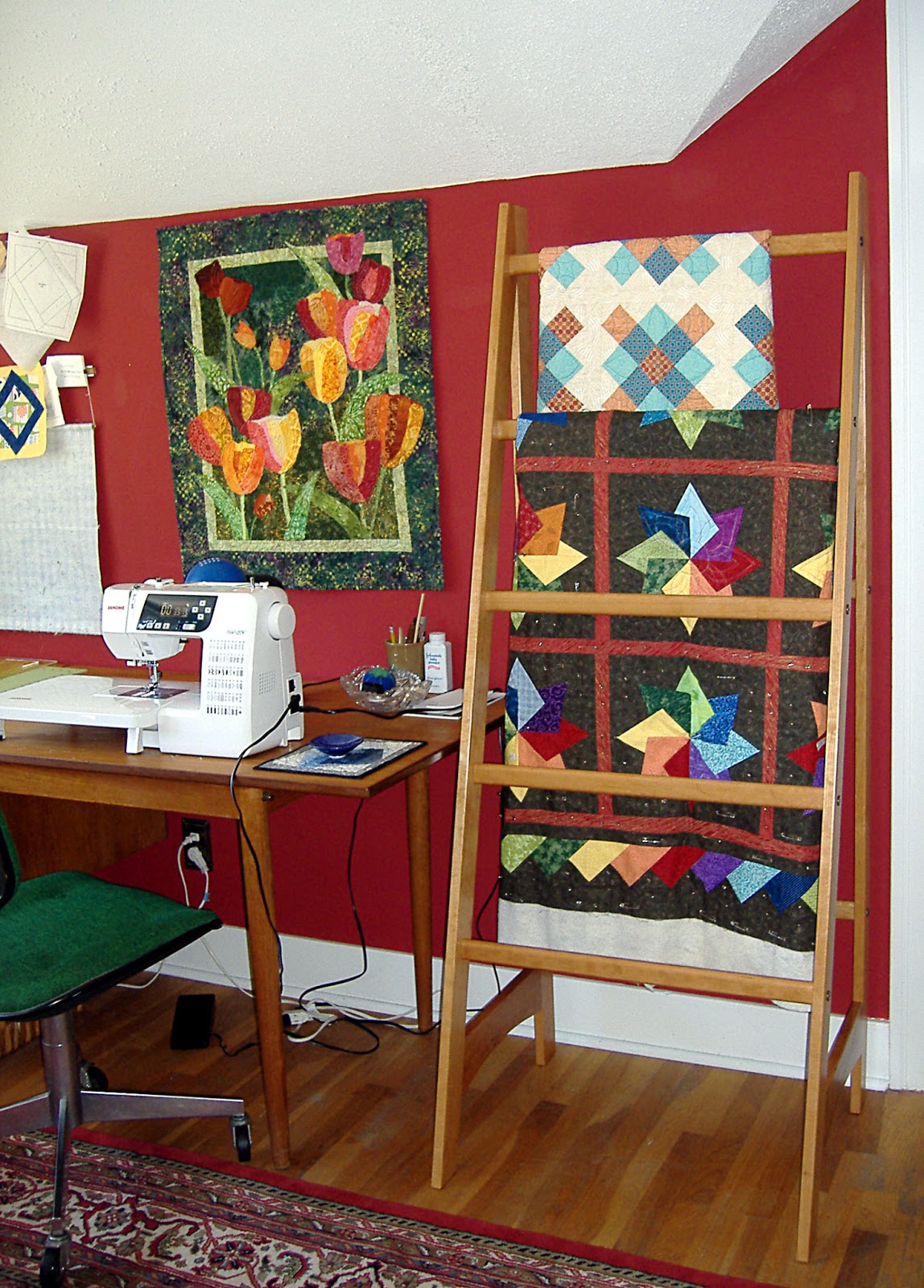
Cherry Wood Quilt Rack
  One of the first pieces he built for me is an ironing table made to my specs.  It is kitchen counter height, so I can comfortably stand and do my block layouts, pinning and ironing.  It has drawers and shelves for all my supplies.
Ironing Table
 I was getting frustrated with my sewing machine setup for quilting.  I had to reach up, even after I put a large pillow on the chair.  I had no real room for my elbows.  Shoulder cramps were the norm.  So I asked him to build me a custom sewing table.  My Janome 6600 fits snugly onto a sunken platform with its sewing bed flush with the table top.  Tom finished the heck out of the table surface so that I will barely need my Supreme Slider. The top has a flip up extension to support larger quilts.  There are 2 drawers for my quilting threads and the shelf that the machine actually sits on is extended to hold three long trays for quilting tools.  It arrived yesterday, so I am going to test it this morning – but I can already tell how much better this set up is going to be just by sitting at it.  It was dimensioned to fit against a white formica topped kitchen table.  It can extend as well.

My new sewing table extended (the ironing table is in the background).


Side view of the new sewing table showing all the nice storage!
The really cool thing is he made it from his wood stash (yes, just like us sewing from our fabric stashes) and it is so sturdy and pretty.

On another note: I ended up dropping out of the Year of Lovely Finishes group.  One of the main benefits of retirement in my mind is the lack of deadlines and schedules.  So I felt it silly of me to impose one.  However, I have been finishing projects at a fair clip.  I knitted a bunch of baby clothes as well as a 2 pairs of socks and a sweater for me (see them on my Ravelry page ) 

 I finished the quilt I was talking about on my last blog entry – it even was done for the shower.  
Born To Ride - completed.
 Yesterday I finished a kaleidoscope quilt a la Ricky Tims.  I have one finished top that I am going to work on next.  All in all, it’s been a productive several months, which is why the blogging rate has suffered.
Springburst - 45"by 45"
Springburst Quilting Detail